

Authors: Tian Jiaqi, Tung Portia, Xue Jingyi
“Hard work, unity, and discipline” is the opening sentence of Grameen China’s Six Decisions. During members’ weekly group meetings, this phrase echoes throughout Grameen’s offices.In Grameen’s lending model, a special set of regulations governs its members, known as their Six Decisions.
The six decisions act as an invisible string, linking the members and their daily lives, and serve as a core guideline for their participation in the program.
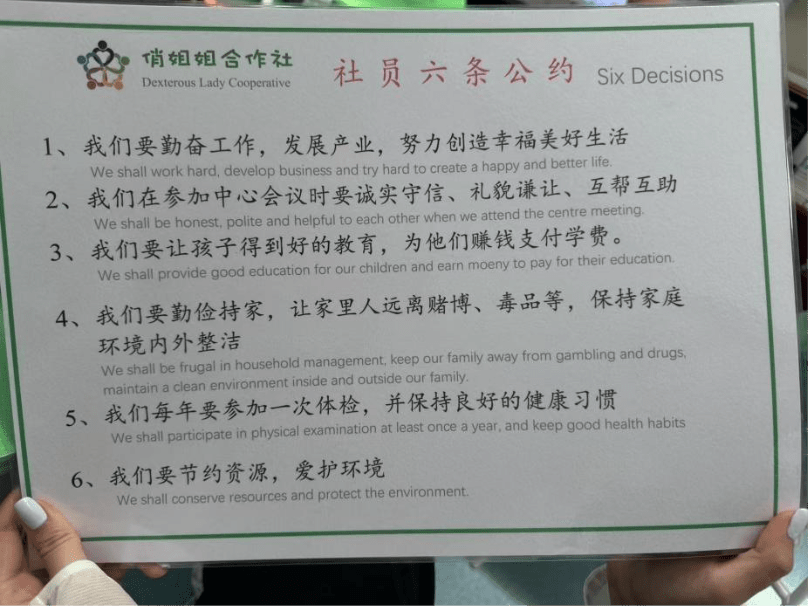
The six decisions encompass all aspects of members’ lives, including their social relationships, families, and education. Specifically, they are: “1. we will work hard, be punctual and follow rules, help each other, and avoid bad habits; 2. we should meet in a safe and comfortable place; 3. we should safeguard our children’s education; 4. we should have regular medical check-ups and pay attention to our health; 5. We should use clean and hygienic toilets and pay attention to hygiene 6. We should conserve resources and protect the environment. “
Behind these seemingly simple decisions lies the shared aspiration of Grameen members to pursue a better life.
Localization of the Six Decisions: Transformation from Bangladesh to China
Grameen China’s six decisions are based on the sixteen decisions formulated by the Grameen Bank of Bangladesh in 1984.
In 1976, Grameen Bank founder Muhammad Yunus met a young woman named Sofia in the village of Jobra and learned about her experience of being exploited through small loans with high interest rates. Yunus was deeply shocked and began to think about how to help these poor families escape poverty. He then discovered through investigation that there were 42 people in the village who had similar experiences to Sofia. Yunus immediately took out 856 taka and lent it to these 42 people. Later, they all repaid their loans, and their lives improved significantly after escaping the exploitation of usury. This experience made Yunus realize that poor people will repay their loans, which became a key catalyst for the establishment of Grameen Bank.
As Grameen developed, Yunus increasingly realized that simply providing financial support was not enough to fundamentally change the lives of the poor. They also needed guidance to develop better life and development concepts. In 1984, Yunus organized a national conference attended by 100 women’s center leaders to discuss women’s aspirations for a better life. The topics ranged from educating children and improving family hygiene to developing sustainable home-based businesses. The resulting charter, proposed by the participants, covered not only economic development but also all aspects of social life. It aimed to guide the poor in changing their current situation and moving toward a better life. This initiative laid a solid foundation for Grameen Bank’s future business expansion and the dissemination of its philosophy, becoming an important action guide for its efforts to serve the poor.
When Grameen introduced the Decisions to China, the Chinese team localized the them, streamlining it into six decisions that were more in line with Chinese culture and more relevant to the lives of rural women in China. Later, the Grameen China team simplified it into easier language, allowing its members to understand the Decisions thoroughly.
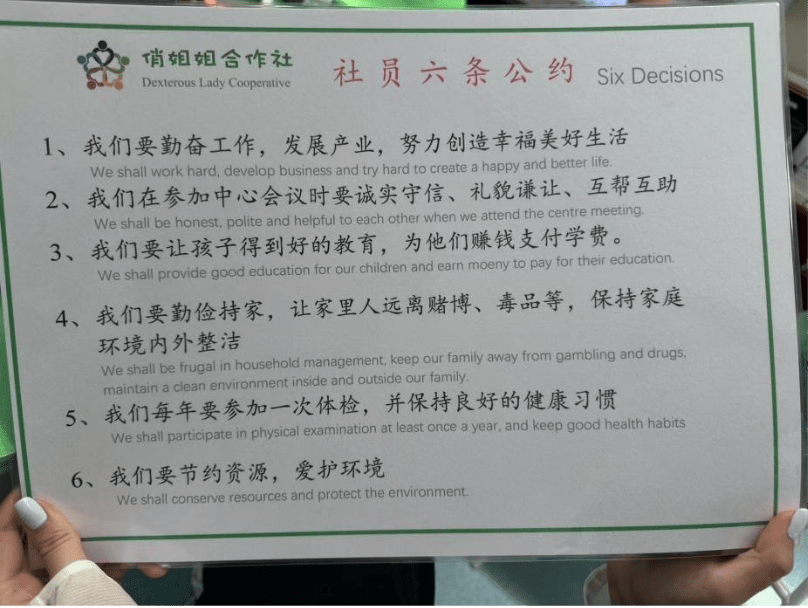
Ms. Zhu, the Center Manager of Grameen China, emphasized, “When we implemented the first version of the Decisions in China, we found it difficult to explain the real meaning of these decisions to our members. The text was too formal to be communicated to members in the local dialect. So we adjusted the content of the Decisions, and the second version of the Decisions is more concise and easier for villagers to understand and implement.”
Gentle Transformation: The Implementation of the Six Decisions
Grameen China integrates the Six Decisions into everyday life through a systematic yet gentle approach.
The implementation begins with centralized training. During a five-day onboarding, staff explain each decision in detail, emphasizing that while there are no penalties for noncompliance, these are moral standards members are encouraged to uphold.
Behavioral reinforcement is built into group norms. For example, punctuality is emphasized by delaying loans if any group member is late. “If one person is late, the entire group’s training and loan disbursement are postponed,” says Manager Zhu. “The idea is not to punish but to cultivate a sense of shared responsibility and discipline.”This mechanism helps the members to follow the first of the Six Decisions, “hard work, solidarity, and discipline”
Members are also encouraged to practice norms of Decisions during the training meeting. Decision one requires people to “help each other”. During training, when members must sign their names, staff refrain from intervening if someone can’t write. Instead, they encourage peers to assist, planting the seed for mutual support that continues into weekly meetings.
Daily operations reinforce the Six Decisions in subtle ways. Staff do not impose the rules but weave them into conversation and storytelling during meetings.
For instance, to promote annual health checkups (Decision 4), staff share stories of women who discovered illnesses early through medical exams. They create momentum by organizing group appointments, tapping into peer influence. “Everyone else is going, so I’ll go too,” becomes the prevailing sentiment.
Similarly, cleanliness is promoted not through enforcement but through social cues. Some women clean their homes simply because they’re embarrassed to host friends otherwise. This natural motivation often proves more effective than formal directives.
Flexibility is also key. For members with financial difficulties, medical checkups can be delayed until after loan disbursement. “The Decisions are not rigid,” Ms. Zhu emphasizes. “They’re living guidelines.”
Grameen staff see their role not just as supervisors, but as enablers.
“When it’s time for medical checkups, we help members find affordable, trustworthy hospitals,” says Ms. Zhu. To support children’s education (Decision 3), staff contacted Shanghai’s Caoyang No. 2 Middle School and donated over 100 books to rural students. These actions build both trust and tangible pathways for better living.In implementing the Decisions, the role of Grameen staff is not simply to supervise, but also to empower them.
Life Change: How the Six Desicions Empower Women’s Growth
When asked about the most significant impact of joining Grameen, many women say the same thing: they’ve gained confidence and become more outgoing.
Village women lack economic and social independence, which marginalizes them from community life. In Lukou village, for example, before joining the Grameen Bank, many women relied only on small amounts of money offered by their husbands. This economic dependence confined them to family affairs, a pattern of life that exacerbated their social limitations. When they spend long periods alone, they naturally become detached from society.
Joining Grameen breaks this pattern. The first decision fosters respect, unity, and mutual assistance. “Now that I have friends to talk to, I’m much happier” is a common perception shared among the members.
Moreover, the Six Decisions promote financial independence. By discouraging gambling and bad habits while encouraging hard work, women gain the skills and motivation to generate income. In some households in Lukou Village, women now earn more than their husbands, giving them greater control over household finances and their futures.
The Decisions have also helped the members to build a close social network.
Despite living in the same village for many years, many villagers (especially women) are not close to each other. Due to their marginalized position in the family and society, visiting neighbors without a clear reason could be seen as inappropriate and triggers negative comments from neighbors.
Before joining Grameen, public areas lacked privacy, and women had few safe spaces to socialize.
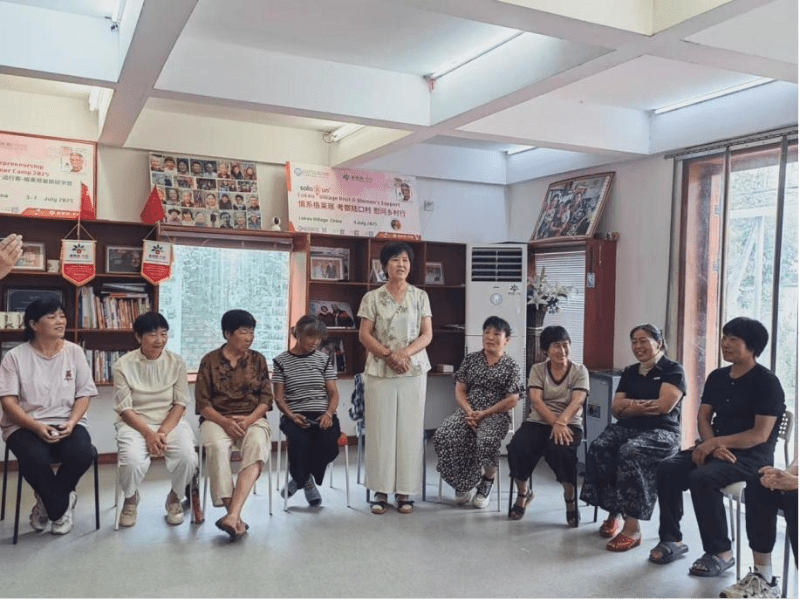
Decision 2—finding a safe and comfortable meeting place—has changed that. The weekly gatherings offer a judgment-free space for women to connect, share stories, and build community. “We talk about our families, and we’ve become close,” many members say. “The meetings are fun and relaxing.”
The Decisions have also improved hygiene and health awareness and improves quality of life.
Before Grameen, most families in Lukou used “mao keng”, an overly simplistic structure that involves a hole and a piece of wood over it. It is unsanitary and unsafe.
Decision 5 encourages formal, clean toilets. “Last year we built a flushing toilet. It no longer smells, and it’s so much cleaner,” said Ms. Wang, a Grameen member, with a smile.
Medical checkups promoted by the Decisions have also become a health guarantee for villagers. Decision 4 stresses the importance of early detection and encourages members to take a medical checkup at least once a year and incorporate healthy habits into their daily lives. Staff frequently remind members: “Early detection, early treatment.” Today, many homes have tiled toilets and disinfected courtyards. These visible changes reflect a deeper shift—women taking control of their families’ health.
The Six Decisions are more than slogans. They represent a shared commitment by Grameen staff and members to strive for a better life. Through everyday practices and mutual support, these decisions have become a quiet but powerful force transforming rural women’s lives. “We’ve never made the Six Decisions as restrictions for the members,” says one staff member. “They are a shared goal—a vision we work toward together.”
 chinaglobaldialogue.com